Treat workforce AI as work design
Start with roles, workload, service levels, decisions and controls. An agent is one part of the operating model, not a substitute for accountable organisation design.
Enterprise AI solution / AI Workforces
Create role-aware agents that extend team capacity while people retain accountable decisions, exception handling and control.
01 / Business trigger
Teams need governed role and process agents to increase capacity while preserving accountability, segregation of duties and human judgement.
02 / Target operating outcome
A governed human-agent workforce with explicit roles, authority, training, measures, operational ownership and periodic recertification.
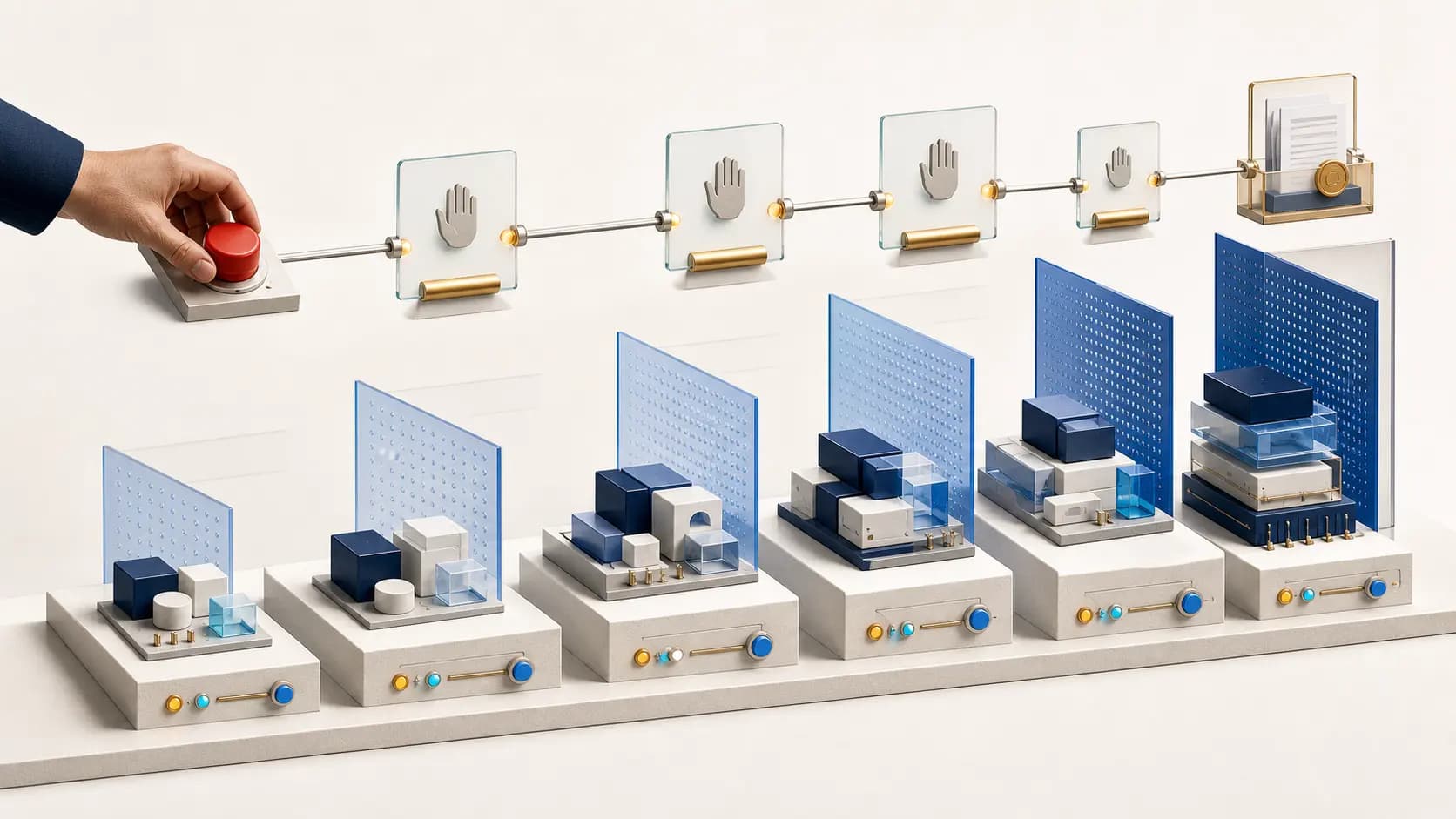
The operating architecture progresses through Business roles, Role and process agents, Knowledge and systems, Human authority, Operating measures.
03 / Operating narrative
Start with roles, workload, service levels, decisions and controls. An agent is one part of the operating model, not a substitute for accountable organisation design.
Assign each agent a bounded purpose, approved knowledge, permitted tools, escalation path and named human owner.
Sales, service, PMO, compliance, finance and operations patterns are adapted to the client workflow, data, systems and authority model.
Agents may research, classify, draft, coordinate or prepare actions while people retain material approvals and exceptions.
Separate initiation, recommendation, approval and execution where risk or policy requires independent control.
Prepare role changes, training, supervision, feedback and workforce measures alongside the technical system.
Review quality, permissions, knowledge, exceptions and value as work, policy and models change.
AI workforces depend on production agents, governed knowledge, trusted controls and managed operations.
04 / Workforce configurations
Each pattern is adapted to the client workflow, knowledge, systems, authority and operating model. None is positioned as an autonomous employee.
Research, qualification, proposal preparation, CRM updates and follow-up.
Enquiry handling, case classification, knowledge retrieval, response preparation and escalation.
Actions, dependencies, risk signals, status preparation, budgets and milestone review.
Obligation mapping, evidence gathering, control checks, issue preparation and accountable review.
Document handling, reconciliations, analysis, workflow preparation and exception routing.
Service triage, knowledge retrieval, runbook support, change preparation and incident coordination.
05 / Delivery system
The engagement starts with the strongest entry point for the operating outcome, then draws on the service stack required to reach acceptance.
06 / Authority and safeguards
07 / Engagement and acceptance
Acceptance evidence. Roles, handoffs, authority, quality measures, training and service ownership are accepted before the workforce configuration enters operation.
Boundary. Packaged workforces are controlled configurations, not autonomous employees or prebuilt products that work without client process and data design.
09 / Qualified conversation
Share the business trigger, accountable owner, measurable baseline, timing and desired operating result.